Salesforce Commerce Cloud: Storefronts & Architecture
Commerce projects go wrong early when teams treat Salesforce Commerce Cloud as one interchangeable platform. It is better understood as a portfolio of distinct products and architectures: B2C Commerce for consumer storefronts, B2B Commerce for account-based purchasing on the core Salesforce Platform, and separately scoped capabilities such as Order Management.
A retailer replacing a consumer storefront, a manufacturer opening a buyer portal, and a business orchestrating fulfilment may all say they need “Commerce Cloud”, while actually requiring different licences, environments, skills, and implementation partners. This guide separates those choices before examining the features, because choosing the right product family is the first architecture decision.
Commerce Cloud is the familiar name, and it remains common across teams, learning resources, and parts of the product. Salesforce’s current official product name is Agentforce Commerce. This guide uses “Commerce Cloud” throughout for readability while covering the same core job: running B2C, B2B, and D2C digital commerce on Salesforce.
🛒 What is Salesforce Commerce Cloud?
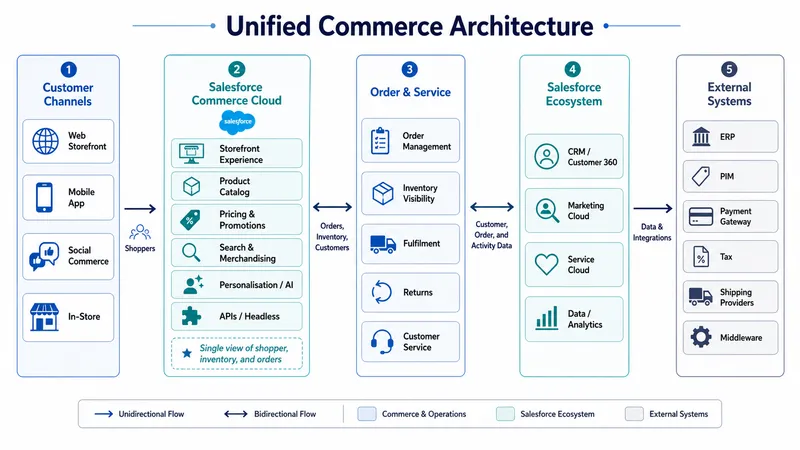
Section titled “🛒 What is Salesforce Commerce Cloud?”Salesforce Commerce Cloud is a cloud-based e-commerce platform that enables businesses to deliver unified, personalised shopping experiences across channels including web, mobile, social, and in-store. It provides tools for managing product catalogues, processing orders, and engaging customers while connecting commerce data with Salesforce CRM. Two major product families are B2C Commerce, for direct-to-consumer storefronts on its dedicated commerce architecture, and B2B Commerce, for buyer-facing self-service stores built on the core Salesforce Platform. These are product families rather than two editions of one product. Packaging such as B2B Growth or Advanced, plus capabilities including Order Management, Data 360 (formerly Data Cloud), and Agentforce, can carry separate edition, licence, or consumption requirements, so validate the complete product mix before designing the implementation.
🧭 Choose the Product Family Before the Storefront
Section titled “🧭 Choose the Product Family Before the Storefront”| Need | Start with | Architectural consequence |
|---|---|---|
| High-scale direct-to-consumer retail | B2C Commerce | Dedicated commerce realm, APIs and B2C development model; access is not provided by a normal Salesforce Developer Edition. |
| Account-based B2B self-service purchasing | B2B Commerce | Runs on the core Salesforce Platform and uses familiar CRM data, Apex and LWC patterns, but still requires a B2B Commerce licence. |
| Headless B2C storefront | B2C Commerce + Composable Storefront/PWA Kit | Frontend freedom increases, along with responsibility for hosting, integration, release engineering and performance. |
| Cross-channel fulfilment and returns | Order Management | Treat it as a separately scoped product and integration programme, not a feature automatically included with either storefront. |
The decision should follow the selling motion and operating model, not whichever demo looks best. Confirm packaging, environments, usage entitlements and add-ons in writing before committing to a target architecture.
🧰 What the Commerce Architecture Must Support
Section titled “🧰 What the Commerce Architecture Must Support”Choosing the product family is only the first decision. A production commerce solution must also keep catalogue, pricing, shopper access, checkout, orders, and external systems consistent when data arrives late or a dependency fails.
| Capability | Design question | Failure to plan for |
|---|---|---|
| Catalogue, pricing, promotions and entitlements | Which system owns each value, and how quickly must approved changes reach each storefront? | Conflicting promotions, incorrect buyer pricing, stale products or imports that miss a launch window. |
| Storefront model and release ownership | Which supported storefront model fits the chosen product family, and who can build, deploy and support it? | A storefront built on a model the team cannot safely extend, release or operate. |
| Identity and buyer access | Who may browse, buy, approve orders and see account-specific products and prices? | Shoppers see the wrong catalogue or pricing, or legitimate buyers cannot complete an order. |
| Search and personalisation | Which catalogue data, shopper signals, consent rules and buyer entitlements shape search, sorting and recommendations? | Results are irrelevant, expose ineligible products or use data without the appropriate consent. |
| Checkout dependencies | How do payment, tax, fraud, inventory and shipping behave when a service is slow, unavailable or returns an uncertain result? | Abandoned baskets, duplicate authorisations, overselling or orders stuck between systems. |
| Order lifecycle | Is Order Management in scope, and which system owns routing, fulfilment, cancellations, returns and refunds? | Storefront status diverges from the operational truth held by ERP, warehouse or payment systems. |
| Peak operation and recovery | Has the complete journey, including dependencies and recovery paths, been tested under expected and peak volume? | Search, pricing, checkout or downstream services fail during the busiest trading period. |
For B2C Commerce, coordinate planned load tests with Salesforce Support in advance so the expected traffic is not blocked as suspicious activity.
🔗 How Commerce Cloud Complements Other Salesforce Clouds
Section titled “🔗 How Commerce Cloud Complements Other Salesforce Clouds”Commerce generates the richest behavioural data in the stack (what people browse, buy, and return), and its value compounds when the other clouds can act on it.
- Sales Cloud: Surface high-value B2B buyer activity, account context, and pipeline signals to inform merchandising, account-based selling, and quote-to-cash workflows.
- Service Cloud: Give support agents a complete view of orders, returns, and shopper history so they can resolve cases faster and turn service moments into retention opportunities.
- Marketing Cloud: Feed cart abandonment, purchase, and return events into journeys so follow-up messaging reflects what shoppers actually did.
- Data 360 (formerly Data Cloud): Unify shopper, order, and engagement data into customer profiles that can support segmentation, personalisation, and Agentforce experiences across Salesforce.
👥 Roles That Commonly Use Commerce Cloud
Section titled “👥 Roles That Commonly Use Commerce Cloud”Commerce Cloud is the most developer-weighted of the major clouds: B2C storefront work runs through dedicated commerce developers, while B2B Commerce on the core platform pulls in the familiar admin and developer pairing. Merchandisers sit at the centre either way, and the B2C versus B2B choice changes the skill mix more than team size does.
- Merchandisers and Digital Marketers manage catalogues, promotions, content, and campaign performance.
- Salesforce Admins support configuration, user access, data quality, and operational reliability — particularly for B2B Commerce running on the core platform.
- Salesforce Developers build custom storefronts (often using the Composable Storefront / PWA Kit), APIs, and Apex/LWC extensions for B2B Commerce.
- Salesforce Architects define integration patterns, headless architecture, data governance, and scalability standards across the commerce ecosystem.
🧭 Best Practices for Maximising Salesforce Commerce Cloud
Section titled “🧭 Best Practices for Maximising Salesforce Commerce Cloud”- Maintain Clean Data: Regularly audit product, customer, and order data to remove duplicates and outdated records. Reliable data underpins accurate recommendations, search, and reporting.
- Leverage Reports and Analytics: Use real-time dashboards to track performance and inform merchandising, marketing, and operations decisions.
- Automate Repetitive Workflows: Automate order processing, inventory updates, and customer communication so teams can focus on strategic work.
- Prioritise Security and Compliance: Protect customer data and comply with regulations like GDPR, CCPA, and PCI DSS to maintain trust and avoid legal risk.
- Focus on Personalisation: Use Einstein and Agentforce to tailor recommendations, search, and promotions — personalisation directly drives conversion and retention.
- Optimise Front-End Performance: Fast load times reduce bounce rates and lift conversion. Monitor Core Web Vitals and tune for mobile.
- Embrace Omnichannel Fulfilment: Support patterns like BOPIS, ship-from-store, and curbside pickup to meet customer expectations and improve margins.
- Regular Testing and Quality Assurance: Continuously test storefronts, integrations, and checkout flows to catch issues before they affect revenue.
The operational failures are predictable: catalogue feeds arrive late, promotions overlap, inventory is stale, payment or tax services time out, and a peak event exposes a dependency that was never load-tested. Give every integration an owner and fallback, rehearse order recovery, and test peak traffic against the full path through search, pricing, inventory, checkout and fulfilment—not only the storefront page.
🚀 Getting Started with Salesforce Commerce Cloud
Section titled “🚀 Getting Started with Salesforce Commerce Cloud”To effectively learn Commerce Cloud, combine hands-on Trailhead content, official documentation, and practical project experience. This blend builds both conceptual understanding and applied skill.
Begin with Agentforce Commerce: Quick Look and Salesforce B2B Commerce Basics, then progress to the broader Agentforce Commerce: Sell Everywhere, Anytime trail for a deeper understanding of merchandising, promotions, order management, and the buyer experience.
For platform updates, architecture guidance, and developer tooling, visit the Salesforce Commerce Cloud Developer Center and the B2C Commerce Developer Documentation.
Practical experience matters as much as the theory, but the org type and product licence are separate concerns. Salesforce documentation can list B2B Commerce as compatible with Developer Edition while still requiring a B2B Commerce licence for its commerce objects and storefront features. A normal free Developer Edition org does not automatically provide that licence, so use a product-specific trial, a partner environment, or an employer-provided sandbox for hands-on B2B work. B2C Commerce likewise normally requires access to a provisioned realm and sandbox through an employer, implementation partner, or Salesforce programme.
🏁 Conclusion
Section titled “🏁 Conclusion”Commerce Cloud can remove a great deal of undifferentiated storefront and order work, but only after the product boundary is right. Choose B2C or B2B from the selling motion, scope Order Management and AI as explicit dependencies, and design recovery around the systems outside Salesforce. The strongest commerce architecture is not the one with the longest feature list; it is the one the merchandising and operations teams can keep accurate during the busiest hour of the year.